![]() |
![]() |
Professional Bushcraft, Wilderness Journeys And College-Level Immersion Programs Since 1999 Skill - Journey - Craft - Nature - Culture - Sustainability - Self |
![]() |
![]() |
|
|
I spent the last week of August paddling Maine's Allagash Wilderness Waterway with fellow Master Maine Guide Ray Reitze, Jr. Ray has been guiding trips on the Allagash and other Maine waterways for over 15 years. His guide service and school of wilderness living, Earthways, is located in Canaan, Maine. Ray grew up in Maine under the tutelage of a native elder who taught Ray the lifeways of his people and the skills of living in the north woods. Ray passes on these skills through his guided trips, wilderness living skills courses, and philosophy courses. Our party of eight traveled in four of Ray's handmade wood and canvas canoes.
We spent the first night at Churchill Dam, and put in the next morning just below Chase rapids at Bisonette Bridge. The first morning was spent getting used to the river, the canoes, and our paddling partners. There were many rocks to be avoided, but the sun was shining and the birds were singing, and we were all happy to be where we were. We paddled to Chisolm Brook, where we stopped for lunch. After lunch, Ray got everyone out in the water and taught the basics of paddling and poling. The experience level of the participants ranged from complete novice to experienced whitewater paddlers, but everyone learned something. As the wind was blowing, we decided to spend the rest of the day there, have dinner, then push off across Umsaskis and Long Lakes around dusk when the wind died down. After a big pasta dinner, we loaded up and pushed on. Umsaskis Lake was still choppy, but was calming quickly. We paddled into Long Lake at dusk, and continued north until it was almost dark. The wind had completely died, and the water was still and peaceful. We stopped at Sam's and set up camp in the near-darkness. The following morning temperatures were in the low 40's, so a hot breakfast of oatmeal, herb tea, and coffee was welcomed. Long Lake was covered in a thick fog, but by the time we were packed up and ready to go, the fog had pulled away from shore. We paddled into the fog, watching it slowly burn off around us.
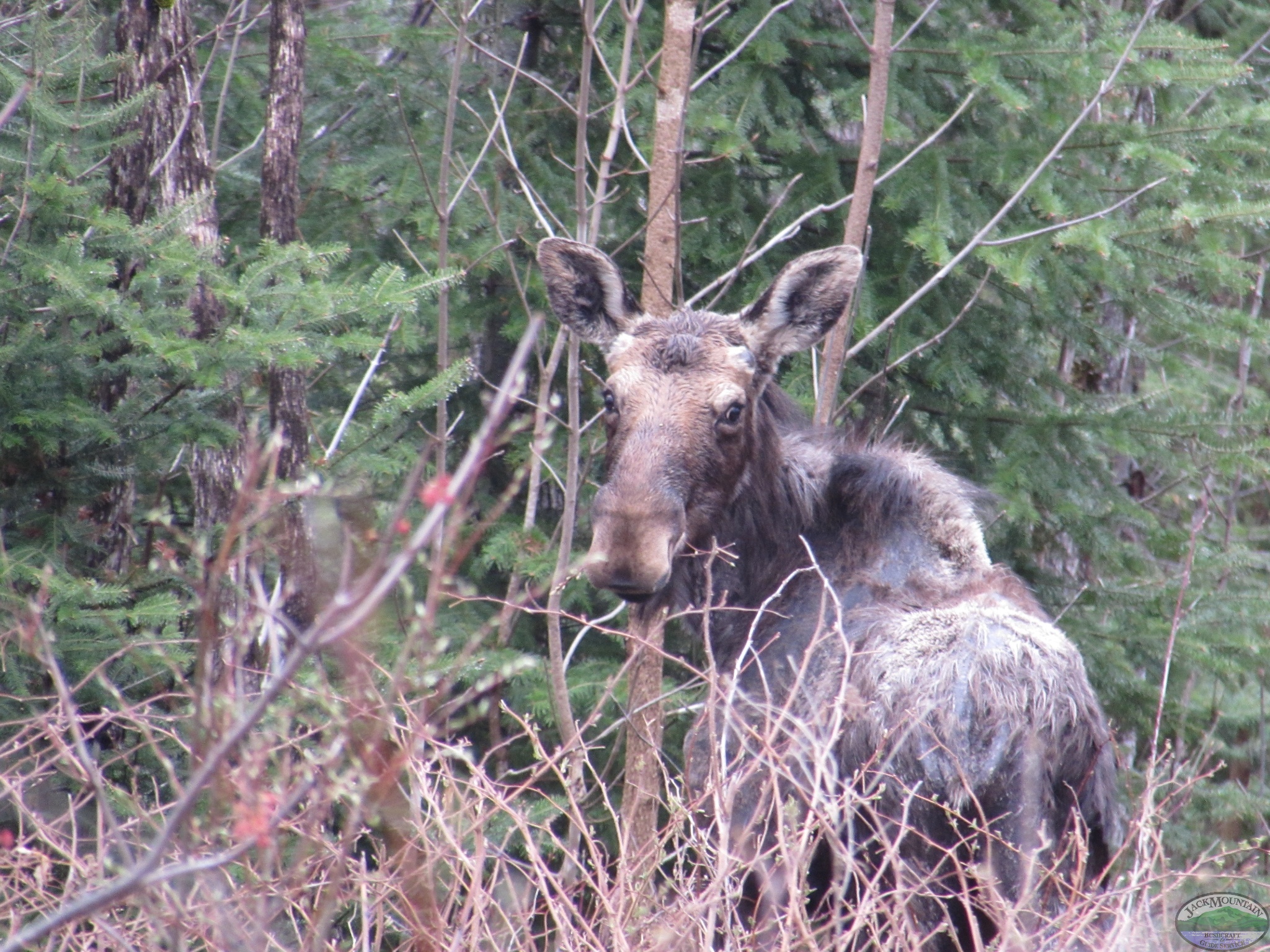
At Long Lake Dam, we unloaded our gear for the short portage. After a short rest, we were back in the water, heading for Cunliffe Island. We arrived in the early afternoon, and quickly set up camp and had lunch. Looking around camp, I found some black bear tracks. She had walked over the pre-existing tracks of a raccoon, so I pictured in my mind the raccoon having a fish and the bear chasing him. Across the river from camp Adam found a bear skull. We looked at it for a long time. Ray wanted to see the bear tracks, so I showed him and Adam where they were. After he looked at them he smiled, then pointed to a smaller track nearby that I had missed. It was a bear cub. A mother and cub had come out of the bushes, walked along the bank, then crossed the river. There was lots of other bear sign in the area, but the combination of the skull and the two sets of tracks made me feel welcome by the bears. I went with Ray to get firewood, poling upstream and loading two canoes with dead, dry wood. When we got back, we started a fire and put dinner on. After dinner I decided to go for a swim. Leaving the conversations of camp behind, I made my way into the water. Looking upstream, I noticed a cow moose feeding on the aquatic plants about fifty yards upstream. She was looking at me quizzically, trying to figure out what I was. Had I been standing, she would have known me for a human, but all that was out of the water was my head, the rest of me swimming and hanging onto the bottom. I called out to those at camp that there was a moose in the river, and they all came down to see. They were another fifty yards downstream of me. After a while, I made my way to shore and dried off. I bet that moose is still talking about the funny creature she saw in the river one evening. The next day we set out early, with a long day planned. We navigated the section of river leading into Round Pond without mishap, although it did rain on us a bit. After paddling across round pond, there is a series of rapids known as the Round Pond Rips. It was here that disaster struck our party. I was bringing up the rear of the group, poling slowly down through the rapids. When I came around a bend in the river, I saw one of the 18 foot canoes broached on a rock, with a broken gunnel and a hole in the hull. The current had it pinned to the rock with the ends bent slightly around. The two people on the rock both wore long faces. Looking downstream, I saw Ray poling up the rapids. I brought my canoe into an eddy behind a rock, and told my partner to keep the boat in the eddy. Getting out of the boat, I made my way to the rock that the canoe was pinned against. Ray was there too, as well as the two who had been in the canoe. We got on one end of the canoe and tried to lift it out of the water, with no luck. On our second try, though, we were successful. This was a stroke of luck, though, as there were several tons of pressure pushing the canoe against the rock. We were able to succeed because the canoe wasn't pinned exactly in the middle. Once we had one end free, we could roll it over and examine the damage. There were several holes in the bottom, one gunnel was broken, six ribs were cracked/broken, and several of the planks as well. Ray had a big smile on his face as he explained that we were going to fix it with materials from the forest. We emptied the water out, then flipped the canoe upright. Ray hopped in, pole in hand, and quickly stomped down on the broken ribs to straighten them out, then poled downstream into a big eddy.
When he hopped out of the canoe, we lifted it onto the rocks and put duct tape on the holes. The gear that had been in it was transferred to other boats, and we continued on down the river. The broken boat was in a precarious position; the ribs had been straightened out and the holes patched, but the ribs would quickly buckle if another rock was hit. Carefully, we paddled another mile to the campsite at Croque brook. Once there, we had lunch and started a fire to dry out gear that had been soaked. Then Ray, Adam, and I got into the 20 footer and poled across the river. We had with us an axe and a small homemade bucksaw, and each of us had our sheath knives. We found a dry cedar log that was lying on the ground, and using the axe and saw cut a section from it, then split the section so as only to take the good wood with us. We also gathered three spruce saplings. With our raw materials, we poled back across the river to the campsite. Using the axe, Ray split blanks for three ribs from the cedar log. Adam and I were busy limbing and peeling the spruce saplings, which were to become a brace for the gunnel. Once we had them cleaned up, we began to shave the wood into a half-round, to facilitate bending and to have it sit nicely in one place against the canoe. We had this done in about 40 minutes, then began to work on carving a rib from a cedar blank. We ended up carving one rib that night before darkness set upon us, and we soaked it in the river overnight to make it bend easier. In the morning we checked on our cedar rib. It still didn't want to bend just right, so we decided to soak it all day and try it again that night. In its place, we gathered several spruce saplings, limbed and de-barked them, then shaved one side of the thick end. Then we bent them into the hull over the ribs, and snapped them under the gunnels. We had to pull them out several times and remove more wood to get them to bend just right, but in an hour we had three spruce helper ribs over the original cedar. We loaded the damaged canoe a bit differently, with two light bags sitting on top of the new spruce ribs. Other than those two bags, it was empty. The 20 footer was loaded with most of the gear the damaged canoe had carried, which gave us more to play with to get the proper downstream-heavy trim.
We set out that morning confident in the work that we had done. That night we added several more spruce ribs. We never took the time to boil the cedar rib, as the spruce ribs worked great. We did bring it home with us, though, to show others what could be done in the bush with simple tools. The next day we stopped at Michaud Farm to check in with the ranger. She came down to the river to see our field-repaired canoe. After a few crackers, we pushed on to Taylor's Landing. After setting up camp, we cut three more spruce poles for ribs, then had dinner. After dinner, Ray made his famous Bush Doughnuts for the group. We ate a bunch of them, and saved a bunch more for lunch the next day. Tired from our travels, we all turned in early and slept soundly.
The following day we spent some time exploring the abandoned Moore farm. A wealth of knowledge, Ray related the history of the place to us. One of my favorite parts about paddling with Ray is that he knows the history of the river and the people who lived there. He knew the last people to live on the farm, and told us stories about what they were like, and what life was like for them. This living history, rather than book history, made the region come alive. After leaving the farm, we had a short paddle to the portage around Allagash Falls. After carrying our canoes and gear, we went up to look at the falls. Ray told us that two people had gone over the falls. One, a woman, had gotten her legs caught in her rain poncho and drowned. The other, a man from out of state, had been drunk and fallen into the water above the falls. He floated/swam through, and was sitting on the shore below the falls when his companions found him. He had sustained two cracked ribs, but other than that was unhurt. After the falls we paddled on to Big Brook, where we made camp. There was a spring right next to camp, and the water was delicious. Our last morning on the river we paddled to Allagash Village. It took us about six hours, but soon we were at a local restaurant eating more than we should have. It was an educational trip on many levels, from local history to repairing a canoe in the bush. The lessons learned from Ray will not soon be forgotten. For more information on Ray's trips and courses, see his website at Earthways.net.
|
[ back to top ]
|