Big Black River Canoe Trip Journal
May 2005


photo
Dishes Drying On Camp Table On Bank of the Big Black River

        The Big Black river rises in Quebec and crosses into the unorganized townships of the North Maine Woods near the border town of St. Pamphile. It winds its way east and north and runs into the St. John river just downstream of Big Black rapids, nearly doubling the size of the St. John. Although it's on the Allagash/St. John map that's so popular with canoeists and fishermen, it is seldom traveled. Many times I've come down the St. John and passed the point where it flows in from the west, wondering what's upstream and what kind of trip it is. This spring I found out.

        I met the party I was guiding at Pelletier's campground in St. Francis on May 9th. Proprietor Norman L'Italien has provided me with outstanding service over the years shuttling vehicles and dropping me off with clients, and has a beautiful campground on the bank of the St. John. It was a small group consisting of myself, fellow guide Don Merchant, and Mark and Tom, two men who worked for a newspaper. We had a big dinner and got to know one another while watching the St. John flow by.

        In the morning we were up early and had all of our gear and boats on the shuttle truck by 6:15. Tom L'Italien, Norman's son, was our driver. We dropped my vehicle at the Dickey Trading Post and headed onto the woods road. As we drove in we all got to know one another better and the conversation flowed easily.

        About two hours into the trip we were driving on the Maibec-Blanchette road approaching Priestly bridge when we noticed some men and machinery working on it. Tom stopped the truck and we got out for a look at the St. John as he went and talked with the men. They were Quebecois and he had trouble understanding them, but they told him that the bridge was closed and that we'd have to head south and cross the St. John on the Moody bridge, about an hour south. We went back to the truck and Tom called Norman, who told him that the Moody bridge had been damaged by the ice and was impassible. Norman knew the foreman of the bridge crew from his days working in the woods and spoke with him on the cell phone. It was decided that they'd take a break and allow us to cross the bridge on the timbers they were laying. In ten minutes we were across the bridge and heading for the border at St. Pamphile. Were it not for Norman knowing the foreman we would have had to go back to Dickey and take another road to get to the Big Black, which would have taken the rest of the day. Had I not already been a lifetime customer of Norman's, this would have been more than enough to make me one.

        Our route to the put-in took us to within a quarter-mile of the border crossing at St. Pamphile. One of the guys wanted to stop and talk with the customs officer about launching in Quebec and floating across the border. We were informed that it was illegal and a $5000 fine. So, we got back into the truck and headed south to a bridge that crossed the river a few miles south, staying on the US side.

        At the bridge we unloaded gear, shook hands and thanked Tom (our driver), and began loading one of the boats. Since Tom and Mark were interested in seeing the border and the map showed it was only three or four river miles from the bridge, I got in the 18'6" boat with them and started poling upstream. The water was high and there were few eddies, so it was a lot of work to get the boat upstream. After poling for a while the three of us paddled for a short bit, then I went back to poling. We alternated like this for a mile and a half, then pulled over to the riverbank and had a look upstream. We could see upriver about three-quarters of a mile and still didn't see the border, so we decided to head back downstream. We floated lazily with the current over the course of our laborious upstream travel. What took us an hour and a half to get upstream we covered in 15 minutes of floating with the current.

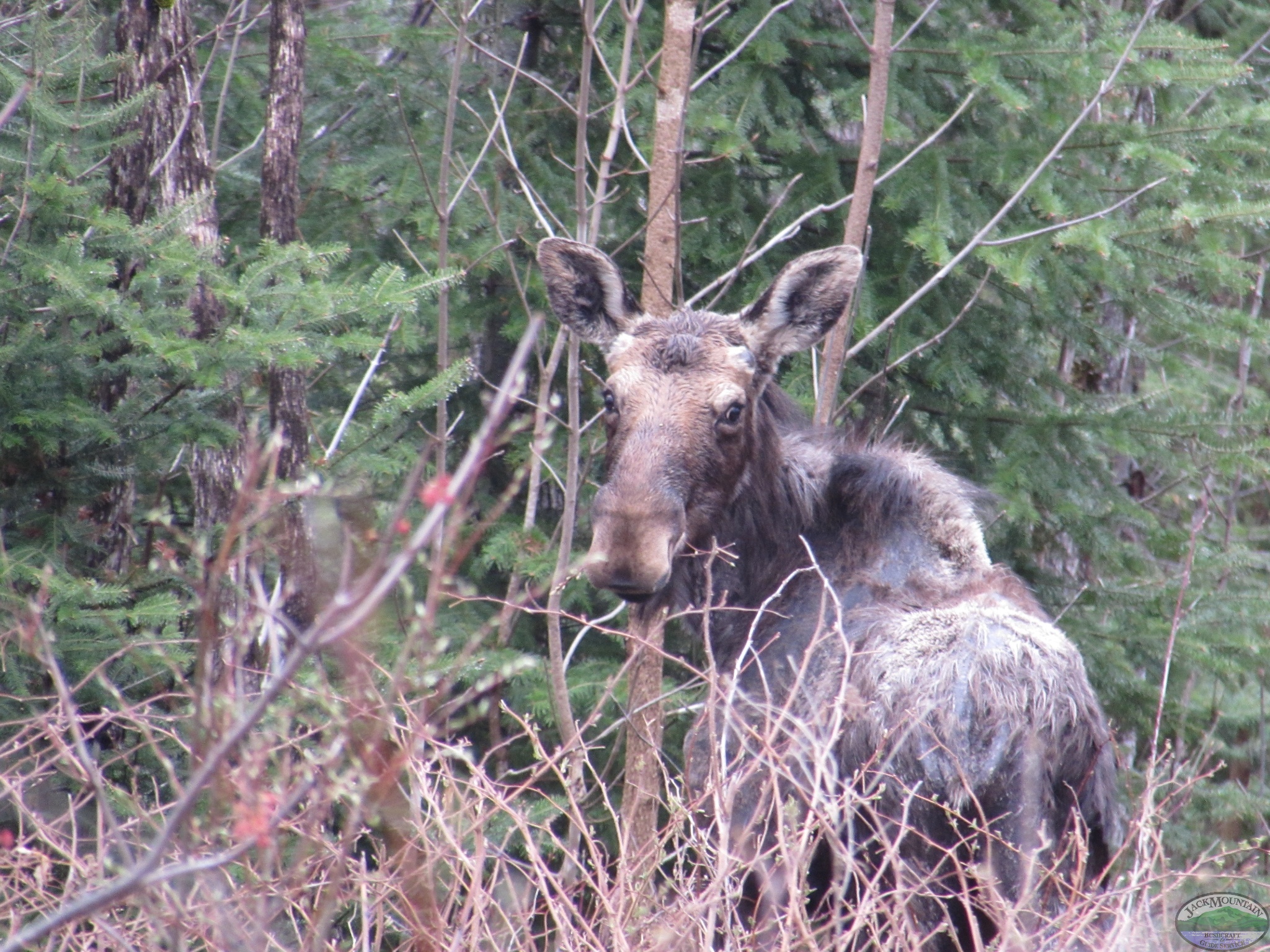
        At the bridge we loaded up both boats and soon we were floating downstream out of sight of the bridge. At this point the Big Black is about 40 feet wide, similar in size to the St. John as it exits Baker lake, and made up of alternating quickwater and class 1 and 2 rapids. After about an hour we stopped on the riverbank for lunch. We sat in the dead grass and ate our fill. By habit, I was investigating the muddy riverbank for tracks and found clear moose and deer prints. There was also a bunch of beaver sign. Before long we were back in the boats heading downstream.

        As we rounded a bend in the river where Depot Stream entered on the right, we saw several cabins along the left bank of the river. Paddling closer, we saw two women planting flowers along the bank. As they saw us approaching they remarked to one another that they didn't know if we were French-speaking Quebecois or English-speaking Americans. We greeted them in English and they asked us what time it was. It wasn't long before a man strode out to the riverbank from behind a cabin and introduced himself as Rod Sirois. The reason they needed to know the time was because one of the women needed to get across the border before it closed at 5pm or she wouldn't be able to get to her house in Quebec until the border opened at 9 the following morning. We chatted briefly and Rod invited us ashore to talk and have a look around his camp. (Rod's camp is called Northern Hideaway)

        We tied up the boats and came ashore, then followed Rod as he gave us the tour of the place. We settled into a log cabin and chatted for a while. Rod shared his stories of raising coyote pups and showed us some of the artifacts he's collected on his travels through the north woods.

        Before long our hosts had to leave for the border, so we said goodbye and headed downstream.

        It was late in the day so we started looking for a spot to camp. We found it in a small clearing that Don happened to spot from the river. Once ashore and unloaded, we got some firewood and got a fire going. I built a tripod pot suspension system and put some water on to boil, then wove several grills out of sticks on which to cook our steaks. We rounded out the meal with sourdough biscuits, brown rice, fresh asparagus, and had brownies for desert. With full bellies we turned in one by one and slept soundly.

        In the morning we had oats and sausage for breakfast, then loaded up the boats. We had been watching and listening to the birds all morning, and Mark, whose knowledge of birds was encyclopedic, identified two Merlins and witnessed them copulating.

photo
Beaver Dam Up On One of the Bogans

        We paddled downriver with clouds building throughout the day. After a lunch stop in a riverside meadow, we paddled up several bogans that led into the 9-mile deadwater. We pushed on until we found a nice camp alongside a large stream that came in from the left. Immediately after landing we rigged a ridgepole and set up the tarp. Just as we were finishing it began to rain, and continued to rain for about an hour. We got dinner going and made a few improvements to the campsite before starting a fire and baking biscuits. We decided to spend another night at this campsite and spend the day exploring and improving the camp. As darkenss fell it was considerably cooler.

        In the morning we had a hard frost. Some snow had fallen during the night, but there was no accumulation. We had sourdough pancakes and sausage for breakfast, then we spent some time sharpening knives and axes and busying ourselves cleaning up the campsite. After lunch three of us headed in to the forest and followed the stream up for about a mile. It was clear and fast and I made a note to return sometime and explore it with a fishing rod. When we returned to camp Don had built a table to make our cooking and dishwashing easier. We had dinner and went to bed warm and contented.

        When we woke up the wind was howling up the river corridor. We had breakfast and broke camp, then floated downstream several miles to the confluence with the St. John. The St. John is wide below the confluence, and we worked hard paddling against the strong winds even though we had the current working in our favor. We stopped at Ferry Crossing campsite, located on a bend in the river beyond which was a straight mile-long section with the wind rushing up to meet us. At the campsite were four firefighters from western Massachusetts. We made small talk about the river and they commented on the beauty of our wooden boats. We stayed there for about 20 minutes before pushing on downriver.

        We paddled until about 3pm, then chose to camp for the night at Oulette Farm campsite. After setting up camp our resident birder spotted two more Merlins on the nest and got several photographs of them. I made dinner and everyone pitched in to gather firewood. We had a hot dinner, then relaxed around the fire as the stars came out in a crystal-clear sky.

        In the morning we loaded up and headed downriver for the short trip to Dickey. The wind had died overnight so we were pushed along quickly by the current. As we approached the Poplar Island campsite there was a wall of debris 10 feet deep high up on the bank, a remnant of the ice dam that had been 30 feet deep on the river this past spring. It had ripped the campsite sign down, as well as the sign that read "3 Miles To Big Rapids". We poked around a bit before paddling the last section of river above the rapids.

photo
The Author Poling Down Big Rapids

        At the head of the rapids we pulled off the river and unloaded some gear. Since Don has been nursing a shoulder injury he wasn't going to run the rapid. Mark stayed with him, and Tom and I set off downstream in an empty boat. I poled down the rapids slowly, hugging the left bank. When we rounded the corner I stowed the pole and grabbed the paddle, guiding us around the numerous rocks and making sure we hit all the standing waves head-on. After the first drop I grabbed the pole again, slowing us down and picking a route through the second drop. When we entered the second drop I again stowed the pole for the paddle and soon we were at the foot of the rapid. We had taken on a bit of water as the standing waves were higher than our gunnels, so we pulled off the river and drained the canoe. Then we paddled the remaining mile to the Dickey bridge. I retrieved the van from the Trading Post, picked up Don and Mark, and then we all had a relaxing lunch before heading down the road to Pelletier's Campground and Mark's car.

        Paddling a new river is something I didn't think much about as a young man. As time goes by, though, a new adventure and discovering a new piece of ground or section of river has become more exciting as the list of places I've been grows. Because of this trip, the Big Black is no longer a mystery to me. My curiosity and questions about the river have been replaced with fond memories of a great trip. Perfect weather, great companionship, comfortable water levels, nice campsites, no mishaps, all these things contributed to another enjoyable excursion in the great state of Maine.

[ back to top ]

JMB&GS • P.O. Box 77 • Ashland, ME 04732 • USA
Phone: (207) 540-7632  •  Email: tim@jackmtn.com


Copyright © 1999-2008 Jack Mountain Bushcraft, LLC - All rights reserved.