Jack Mountain Bushcraft Logo Bushcraft And Sustainability Field School
Professional Bushcraft, Wilderness Journeys And College-Level Immersion Programs Since 1999

Skill - Journey - Craft - Nature - Culture - Sustainability - Self


winter bushcraft and survival Registered Master Maine Guide

Programs > Field School > Yearlong Immersion > Bushcraft Canoe Expedition Semester


Bushcraft Canoe Expedition Semester

Bushcraft. Traditional Canoeing. Professional Guide Training. College Credit.

1999-2009 - Celebrating 10 Years And 14 Semester Programs

  2010 Course Info:
 • Dates: 5/2-5/29
 • Maximum Size: 10
 • Tuition: $3000
 • Tuition Financing
      - Apply Now -

[Canoeing in Maine]
Jeff Butler Paddling the Allagash on a Misty Morning

"So many of today's practitioners of bushcraft would like you to believe that bushcraft is a rarefied art form, with only a diligent few acquiring mastery. This is, in my opinion, an elitist approach. Granted, many bushcraft skills require years of dedication to master, but Tim has a knack of making these skills accessible to any person interested in bushcraft. He gives his students the skill set and self-belief for a far more enjoyable, and vastly more enriching, experience of the outdoors. Well-learned Bushcraft enables an individual to develop a more intimate and respectful bond with nature, it also emboldens the individual to rely on their own ingenuity and skills. There was something truly grand and liberating in spending 10 full weeks in the woods, to being outside everyday in the wilds of north Maine. When do we ever get a chance to directly experience and fully appreciate the slow seasonal transformation of summer to autumn? One of my fondest memories of my 10 weeks with Tim was when we had camped beside a remote lake. Our canoes were secured for the night, the campfire was blazing, and slowly but surely a few loons began to let loose their haunting calls across the lake. Eventually, the moon made an appearance through the clouds. That sense of freedom and connection in a place of such great natural beauty is priceless. I don't believe that feeling can always be easily acquired but it can be enhanced through the ancient and evolving art/science of bushcraft. In effect Tim is a gatekeeper of sorts, he teaches bushcraft but he also instils within the willing student - confidence. The confidence to get out there and have our own adventures in the wild. What more can you ask for?"
                                                               
- Sean Fagan, Fall Semester 2008

Spring Semester Overview

What would the ultimate Maine canoe, bushcraft, fishing and outdoor living program look like? We've thought about this for ten years and this comes pretty close.

It begins with our Riverman Course, a week of solid instruction in canoeing, guide training and practical camping and outdoor living. Daily lessons with day trips to nearby lakes and rivers that steadily increase in difficulty, culminating in a run down the Big Machias River.

We'll be working with large freight canoes, learning to pole, paddle and line them both tandem and solo.

After a short break, we'll leave on an 8-day, 105 mile trip on the grandaddy of Maine canoe trips: the remote St. John River. We'll be camping along the river as we paddle the rapids, explore the history, and live the timeless bush life.

When we get back to the field school, the Aroostook River will be starting to warm up and the native brook trout will be getting active. We'll spend 3 days on instruction and field experience with all types of fishing. There's a strong emphasis on fly fishing, but there is also instruction covering spinning and primitive methods. We also spend time fishing the surrounding streams, rivers and lakes, adding valuable field experience and providing delicious fish dinners.

Then we'll head for the Allagash for a final week of camping, fishing, exploring and fine tuning the many lessons of the experience. The trip takes place during some of the peak fishing of the year, and we'll take advantage of it. We'll fish in spots that aren't well-known and that get little fishing pressure. We'll pole most of the way down the river, and discuss the history, both natural and human, of this beautiful region.

The Bushcraft Canoe Expedition Semester is suitable for beginners, but be advised you won't remain that way for long. The whole experience takes place before the black flies and mosquitos come out for the year, during the high waters of May.

It includes a season pass to the North Maine Woods, so you could spend the rest of the summer and fall exploring, camping, and seeing the country.

There's also an option to join us in June for a whitewater trip on Quebec's Bonaventure River, which has 85 miles of white water as it rushes to the sea, at a reduced cost.

When the course is over, you'll have learned the way of the river, how to plan and provision an extended trip, how to manage a group of people safely on a remote river, and how to deftly control a fully-loaded freight canoe. You'll know how to cook delicious meals over an open fire, how to run an efficient and clean camp, and how to tell fishing stories that rival the seasoned raconteur. You'll have four weeks of immersion into the lifestyle, mentoring in the skills, and experience in the bush. You'll have an experience that will stay with you for the rest of your life.

Also, if you're interested in the guiding profession, this experience will go a long way toward teaching you the craft and skills needed to excel. There's no other program like it, anywhere, at any cost.


[photo]
Poling through the mist along
the Maine/New Brunswick Border

The 21 Point Jack Mountain Curriculum

Our educational program has been developed over ten years and twelve semester courses. It's designed as a cumulative sequence of learning experiences where the resulting outcome is greater than the sum of the parts. This is a much different approach than assembling a collection of random skills and activities and calling it a course. Our goal isn't just that a student is able to "do" a skill. Instead it's to develop their knowledge, attitude and physical skills into a cohesive whole.

Our warm-weather curriculum includes:

  1. Wilderness Survival - Basic, intermediate and advanced survival.
  2. Fire - Fire making with and without modern tools.
  3. Shelter Construction - Building for survival, short-term and long-term stays.
  4. Water - Acquisition And Purification.
  5. Navigation - Barehand (using no modern tools), map and compass.
  6. Canoeing - Paddling, poling, lining, portaging, and using traditional gear such as tumplines and wannigans.
  7. Ropework And Knots - Making cord and rope and tying useful knots.
  8. Clothing Science - Choosing and maintaining your clothing for the bush.
  9. Outdoor Cooking - Stone ovens, pot suspension systems, primitive grilling, sourdough baking, reflector ovens, dutch ovens, etc.
  10. Provisioning And Meal Planning For Trips - Choosing appropriate foods, determining amounts, packing, etc.
  11. Outdoor Leadership - Becoming a professional outdoor leader, managing groups in the woods and on the water.
  12. The Knife - Selection, safety, powerful and efficient use.
  13. The Axe - Selection, safety, powerful and efficient use.
  14. The Saw - Selection, safety, powerful and efficient use.
  15. Trip Equipment - Use and maintenance of nylon and canvas tents, stoves, lanterns, tarps, canoes, paddles, etc.
  16. Group Encampment - Safety, cleanliness, organization.
  17. Sustainability - Composting, waste management, sanitation.
  18. First Aid - Dealing with common injuries. Note: This is not a first aid course.
  19. Lost Person - Finding a lost person in the bush.
  20. First-Person Ecology - Studies of the natural world including weather (observational forecasting), plants (edible, medicinal, utilitarian and magical uses), mammals and their tracks, birds, fish, fungi, insects (with an emphasis on aquatic insects) and stars and the night sky.
  21. Crafts - Building useful pieces of gear including a bow drill, a saw frame, a netting needle and net, a canoe paddle, campfire cooking rigs, burned spoons and bowls, animal calls, sleeping mats, pack frames and baskets.

Electives - In addition to our general curriculum, there are other aspects of the bush life that participants can explore if they're interested. These include primitive living (going without modern gear), primitive fishing, fly casting and fishing, and firearm safety and marksmanship. While there are no open hunting or trapping seasons during the course, there are daily opportunities for fishing. If you want to fish, you'll need to get a Maine fishing license. They can be ordered online at Maine Department Of Inland Fisheries And Wildlife. We're very particular about not breaking any fish and game laws on our courses, so you'll need a license even if you just want to put a hook in the water one time.

Sustainability - There are also daily lessons on living a simple, sustainable, rural life. Building and using outdoor showers, composting toilets, solar and fireless cookers, food preservation and storage, organic gardening, and much more.

For more detail on these topics, see the Jack Mountain Bushcraft Student Handbook.


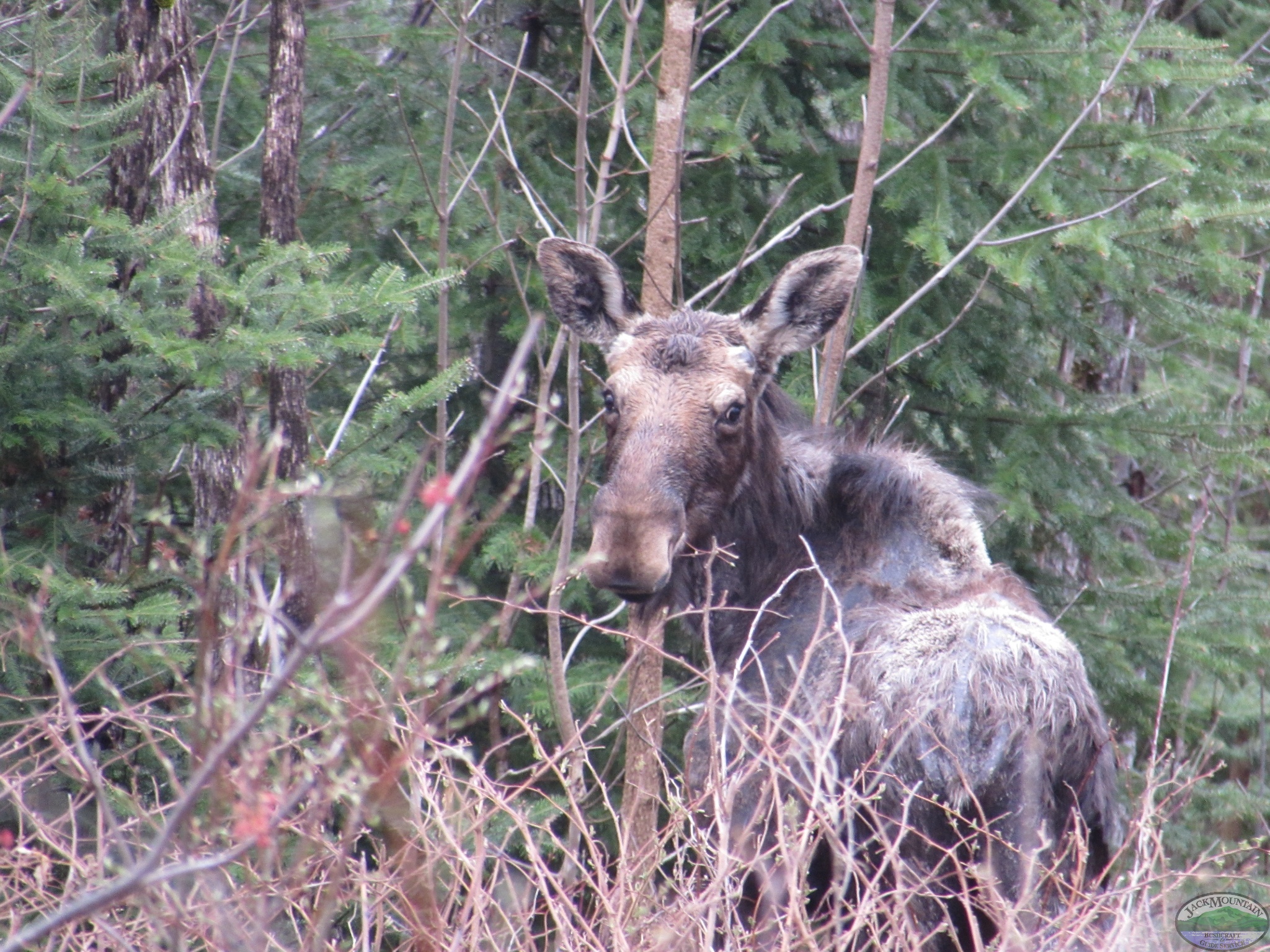
[Moose On The Allagash]
Canoeing Past a Bull Moose.
Click on Picture To See Larger Image

Evaluation and Certification

There are no certifications in bushcraft, wilderness survival or primitive skills that are accepted universally. If any school offers a certification, it's likely a result of their marketing department and probably isn't transferable. None are recognized here. I've crossed paths with numerous people who were "certified" in one thing or another, but in the real world were incompetent, incapable of completing some of the most basic tasks. Thus certified doesn't necessarily mean qualified or competent. Neither does how many courses you've attended, regardless of the school or instructor. What you've accomplished and the experience you've accumulated does. We don't want to certify people. Instead, we seek provide training and field experience and let what they accomplish speak for itself. The way we do that is through our logbook and portfolio assessment system. It records what a student has accomplished instead of placing them in competition with their peers. Students keep a daily logbook during the program to record what they've done. These, along with crafts they've made, projects they've worked on, photographs they've taken, and everything else they've done during the program, are assembled into individual student portfolios.

The portfolio is a factual record what you've done. This way, if someone were to ask if you knew how to start a hand drill fire, instead of saying you took a course on how to do it you could volunteer your logbook and state that you've done it "X" number of times. In this era of people being over-certified and under-qualified, this type of assessment system offers a route back to reality.


Our Educational Philosophy

[tracking on the coast]
Studying Clear Print Tracks on a Maine Beach

Knowledge is power, but knowledge is constructed, not received. It is built incrementally, over time. If teaching were simply telling, then anyone who excelled in a field would be an effective teacher of it. But this transmission model of teaching isn't effective for most learners. Standing in front of someone and telling them what they need to know isn't facilitating learning. Especially when you consider the differences between visual, auditory, and kinesthetic learning styles. We subscribe to the learning model of teaching, where the role of the teacher is to create situations where learning takes place. Students build upon their knowledge daily, and by the end of the experience they've accumulated a storehouse of information and experiences. But the instructor must also make it relevant. It's easy to scoff at friction fire since matches and lighters are so readily available. But remove them from the equation and it's instantly relevant, and the desire to learn the subtleties of the hand drill takes on renewed importance. Our students are actively learning, immersing themselves in the curriculum by necessity. An example of this is how we teach shelter building. You can learn something about a shelter by making one. You can learn more about it by sleeping in it. But to truly know that specific shelter, you need to spend four consecutive nights in it. In this way you're forced to deal with the consequences of shoddy construction or not paying attention to details. Maybe the first night is rough, but it teaches you what you need to do before the second night in order to shore it up and get some sleep. The second night is spent learning some of the subtleties that would make it more comfortable. The third night is fine-tuning it to your specifications, and the fourth night is enjoying the fruits of your labor. If you were to build the same shelter again, you could eliminate the learning curve because you'd know what to do from the outset. That's experiential education.

"Experiential education is the process of actively engaging students in an authentic experience that will have benefits and consequences. Students make discoveries and experiment with knowledge themselves instead of hearing or reading about the experiences of others. Students also reflect on their experiences, thus developing new skills, new attitudes, and new theories or ways of thinking."  (Kraft & Sakofs, 1988)

In addition to passing on traditional skills, we focus on using them to foster critical thinking, problem solving, creativity, curiosity, and a concern with ethical issues.

Summed up in a single word, our educational philosophy is this:  CAN.


Housing, Meals, College Credit and Other Information

[photo]
Set For The Night In A Newly-Built Shelter

Information on housing and meals, as well as other background information, is located on the Field School Programs Background Information page. Past students have received college credit for their work in the ESSP. For more information on how to set this up visit the credit information page.


Get More Information - Videos, Photos And Student Work

To get a better idea of what takes place during the semester, check out these resources:

Also don't hesitate to contact us anytime with questions. The spring semester is a component of our Yearlong Wilderness Bushcraft Immersion Program.


"The benefits of this new awareness are real - I felt them that morning to their fullest when I awoke warm and refreshed, happy as I could ever be."

                                                                - Peter Frost, ESSP Winter 2004. From his journal after spending a winter night without a sleeping bag in a shelter he built and telling time by the moon to gauge how much firewood to use.


[ back to top ]

  Jack Mountain Bushcraft School • Masardis, Maine • USA
Contact • Site Map
 

Copyright © Jack Mountain Bushcraft, LLC - All rights reserved.